"Christ's example is being
demeaned by the church if they ignore the new leprosy,
which is AIDS. The church is the sleeping giant here.
If it wakes up to what's really going on in the rest
of the world, it has a real role to play. If it doesn't,
it will be irrelevant."
- Bono
Tuesday, July 22, 2008 Tuesday, July 22, 2008 "You can fool some people sometimes, but you can't fool all the people all the time."Bob Marley
Although I plan to blog every day - or at least every week, it seems that paying the bills with my other writing gets in the way!
On the up side, we are planning a conference at Colby College on October 18, and I am working on putting that together - more details coming soon.
For now, here is a slightly edited version of my column on the G8 Summit that I sent to the Sun Chronicle. Perhaps my quote for the day should have been "the more things change, the more they stay the same." However, Bob Marley's version of another famous saying also seems to fit.
When I think back to the 2005 G8 Summit, I realize that the world leaders made those promises because millions of people were watching due to the Live8 concerts and publicity. I am more than disappointed that those promises have not been fulfilled. Indeed, the intent to assist those living in the most extreme conditions of poverty seems to have been a cause du jour for most of the world. The concert and tee shirts are distant memories, as are the promises made by the most powerful nations in the world. We are in worst shape now than 3 years ago. When will the pendulum swing back the other way?
...and from my column... As the 2008 G8 Summit ended, few solutions to the global energy crisis, food crisis, climate change came about. The original purpose of these summits was to discuss global economic issues, but in recent years, climate change, terrorism, energy and Africa became part of the agenda. Prime Minister Yasuo Fukuda of Japan hosted this year’s summit in Hokkaido, Japan. The Group of 8, or G8, consists of the leaders of the eight most industrialized nations in the world: Canada, France, Germany, Italy, Japan, Russia, the United Kingdom and the United States of America. For the second year in a row, climate change and the environment were to be the focus of the summit. However, the energy crisis and food crisis took the lead.
Following the turmoil of the 2007 summit, developing nations continue to demand that the eight most powerful industrial nations live up to the promises made during the 2005 summit to aid developing countries. Although the G8 said they would reevaluate current needs and live up to their promises, no short term solutions are on the horizon. Unfulfilled three-year-old promises make a strong statement to those suffering unbelievable poverty.
As to the food crisis, discussion ensued regarding the building up of a virtual world food bank for emergencies. For many developing nations, every day is an emergency, especially when the aid expected is 3 years overdue.
With the weakening dollar contributing the concern over the global economy, the 8 leaders could not reach an agreement on how to handle the fuel crisis, which many believe is due to the speculative market. During the last summit, the price for crude oil hit $70/per barrel - considered high at the time. Just last week, the price dropped over $10/per barrel due to the decline in US consumption. Now, this drop is because of very small grassroots efforts - people like you and me are planning our errands to reduce the number of trips we make and/or just not going out. Imagine what would happen to the price of crude if our government got involved and lowered the speed limit on the interstates as Jimmy Carter did during the last big oil crisis.
In a strange turn of events from the past few years when President Bush refused to acknowledge the reality of green house effects and climate change, he organized a meeting of 16 nations to discuss these issues. Since no short-term goals effecting change came out of the summit, no progress is in the forecast. This meeting came about as news of the US government falsifying and editing scientific reports about these issues for the American public came to light.
China and India, the two developing countries emitting the most emissions, refused to sigh on to any agreements until the US and other major polluters, set the example in their own countries. The "do as I say, not as I do" example that our country sets is obviously not working for these countries experiencing their industrial growth. However, with some of the must polluted cities in the world, and athletes afraid of performing in Beijing, I hope China will start to set the example for us!
Perhaps the relevancy of the G8 Summit is coming to an end. How can a group of world leaders discuss the global economy and climate change without China sitting at the table as an equal partner? How can the developing countries take a group seriously that does not follow through on promises to assist with education, trade and disease? Why would the world follow the example of the US, when our leaders refused to accept that greenhouse emissions even existed and rewrote reports to reflect their beliefs, ignoring the facts? When our president continues to deny that our country is in a serious economic crisis, how can we expect the other world leaders to give us much credence? Bush’s part in encouraging speculative markets in products like corn and soy, used for bio-fuel, as well as the oil market, continues to lead all but the very wealthy down the garden path to financial despair.
Perhaps the G8 needs to reinvent itself. Although discussions are great, in times of crisis, actions speak louder than words. In the past few years, no real action or change seems to happen – just more unfulfilled promises and endless talks, all at the expense of taxpayers and millions suffering around the world. Peace -
"And the thing about my jokes is, they don't hurt anybody. You can take 'em or leave 'em - you can say they're funny or they're terrible or they're good, or whatever, but you can just pass 'em by. But with Congress, every time they make a joke, it's a law! And every time they make a law, it's a joke!" Will Rogers I find it hard to believe that it has been so long since my last post. During this time, a lot has happened, including writing several columns about farming issues and bio fuel. I am also working on events for the fall to spread awareness of global poverty in conjunction with the United Nation's Millennium Campaign's Stand Up.
Finally, after continued delays, the Congress has a poor 2007 US Farm Bill to present to the American people, although farmers with small or family farms will not be happy. This bill, expected to pass through the Senate and House last fall, has been delayed until a few weeks ago. President Bush threatened to veto the 289 billion dollar farm bill, but it passed with such an overwhelming majority in the House of Representatives that the legal debate should end for another 5 years as the Senate votes as we go to press. However, the controversy is far from over.
According to the US Deputy Agriculture Secretary, Chuck Connor, the bill is a missed opportunity to end payments to wealthy farmers. He said, “The president has stated time and time again that he would not accept a farm bill that fails to reform our farm programs, at a time when the farm income and crop prices are setting records.”
The Agriculture Secretary, Ed Schafer, said, “The bill passed today is a farm bill in name only. It does not target help for farmers who really need it, and it increases the cost and size of the government.”
The big controversy is over the subsidies paid to huge corporate farmers. The new bill appears to limit subsidies by stating that business with more than $500,000 adjusted gross income (AGI) will no longer receive support and those people with $750,000 AGI farm income will not receive direct payments. It also states that people with more than one million dollars AGI are not eligible for land stewardship payments unless two-thirds of their income is from farming.
Loopholes in the bill, including waivers, allow for many of the rich to benefit, leaving the struggling farms behind and, for most farmers in Maine, these figures are absurd. Discouraged with the new bill, Michael Vermette, of The Highlands, a farm in St. Albans, Maine, said, “If you have a $250,000 profit, you have no business getting subsidies.”
The bill increases our public nutrition programs by about one billion dollars each year over the next 10 years, including 7.9 billion dollars for food stamps. Over one billion dollars will go to public schools, supplying fresh fruit and vegetables and the Emergency Food Assistance Program will receive 1.25 billion dollars for food banks. This just may make up for the rise in food costs due to the ethanol program.
The bill reduces ethanol tax credits by six cents per gallon. The large meat packers Pilgrim’s Pride Corp. and Tyson Foods Inc. favor these reduced credits. They say that the subsidies for crop-based fuels pushes up the price for corn used for feeding their stock. While large corporations have the ability to ride out the inflated grain market, the tax credit hardly compensates for the hardship that many farmers and ranchers deal with every day.
The bill provides 320 million dollars in loan guarantees for construction of commercial sized plants providing bio fuels, 300 million dollars in mandatory funding for payments to support production of bio fuels, and 250 million dollars in grants and loan guarantees for renewable energy and energy efficient systems for agriculture and small rural businesses. Indeed, this reads more like an energy bill than a farm bill.
With a growing concern of the global food shortages, this bill does little to encourage developing countries to produce food for export as it limits the amount of foods coming into America from foreign sources.
A colleague from Thailand said that many farmers in her country stopped growing rice, as they want to convert their farms into producing bio fuel crops - a decision that contributes to the global rice crisis. Remember, there are alternative crops - not used for food - that leave a negative carbon imprint, which corn does not. We have created a monster through both greed and governments that, although pretending to address environmental issues, put all of us at risk and is extremely detrimental to those struggling to survive in developing countries. Rather than meeting the goals of ending extreme poverty by 2015, the subsidies and food for fuel initiatives have set back progress and caused more death and starvation.
However the bill does provide 84 million dollars in aid over five years for the McGovern-Dole program for school lunches in developing countries. For most students, this is the only meal they have every day, served only during the school year.
With the farm bill debate behind us, we can do little other than focus on the growing season just beginning in Maine and northern New England. As shipping costs rise and large corporate farms continue to receive subsidies and waivers, make a commitment to buy at least $10-$20 in local foods each time you shop.
Better yet, support your local farms and farmer’s market. By working together, we can help to counteract the damage done by this new bill and support small farming endeavors as well as fair trade. By paying attention to our local and national concerns, we also help farmers throughout the world. We must change the current trend and work to undo the damage of this latest, so-called farm bill.
Keep yourself educated on the global food crisis, energy crisis, fair trade, and the damage caused by growing food for fuel rather than people. Remember, we have all the resources to solve these issues, but we must look at the big picture.
Monday, March 17, 2008 Monday, March 17, 2008 "A dream you dream alone is only a dream. A dream you dream together is reality." John Lennon
I find it hard to believe that I have not posted in about a month. I guess that is what happens when you have to pay the bills with your words. During this past month, I worked hard to get a global poverty awareness conference together at a local college. I knew there was interest because I talked with a few students.
I figured that going through campus ministries would be a good idea, and spoke to two of the chaplains. One of them said he would speak to the interfaith council, and then I could come and speak with them. After several weeks and no response to e-mails, it was a no go. To me it sounded as though he was too busy to meet with students who were too busy to meet with him - a sign of the times.
The other chaplain referred me to his faith's council as well as his assistant. The assistant worked hard to contact people, but when they got together, they had no interest. Too stressed? Too worried about spring break, exams, the end of the school year and life, I suppose... However, he referred me to other people and encouraged me to keep trying...
Then, I spoke with a woman who attends that college at the local animal shelter a few days ago. She volunteers at the shelter and I had a foster dog that had an evaluation and training session. She is one of those busy students - active in volunteering and committed to helping others. I told her about my frustration.
As busy as she is, she had several ideas and felt that her college would love to have an event. We will be working on this in the next few weeks and I feel confident that the result will be positive.
With today being St. Patrick's Day - when everyone is Irish by default - I thought about John Lennon. Of course I know he was English and not Irish, but he wrote a song called The Luck of the Irish. It was about the turmoil and the 'troubles' in Ireland. With the hatred in the emerald isle now stabilized, I thought about how hard many in Great Britain - whether in government, churches, or the rock scene - work towards improving life for those in developing countries. I thought about how that bad luck of the Irish that John referred to encompasses so much of the world - and yes, I bet millions of people "wish there were English, too." I thought again about the Amnesty International Instant Karma project and the awesome cover by Green Day of Working Class Hero - another great song by Lennon, in which Green Day focuses on Darfur.
I see a connection between today's quote and the apathy of many students, lay people and ministers regarding holding a conference - this has been a problem in northern New England in both colleges and religious institutions ... When people become so stressed and busy with their daily chores and future plans ("Life's what happens while you're making other plans" - another great line by John), that bringing awareness about our brothers and sisters living in such extreme conditions becomes something we may address next year, I feel as though we are not dreaming together to create fair sustainable future for all of us sharing this piece of rock.
Remember that every year close to 11 million children die as a result of extreme poverty as well as about 7 million adults - that amounts to about 3 Holocausts every single year.
Yes - we have our own problems in northern New England: high taxes; cold weather and tons of snow, resulting in high heating costs; children and families without enough food; low wages; high prices at the pumps; people losing their homes; and poor health care for many. Life is hard. Young adults have tough choices in this region. Most college graduates must move away if they want great paying jobs. Many have friends in Iraq and are concerned about the elections. And those developing countries are so far away...
By dreaming together, we can create a better world. I have to believe this - the alternative is too bitter.
"With our love, we could save the world," said George Harrison.
...and by working and dreaming together, the possibilities are as unlimited as our minds and imaginations...
Tuesday, February 19, 2008 Tuesday, February 19, 2008 Sunrise doesn't last all morning, a cloudburst doesn't last all day, seems my love is up and has left you with no warning. It's not always going to be this grey. All things must pass, all things must pass away. George Harrison I had to quote George Harrison this week - his birthday is less than a week away and mine is in a few days.
I recently interviewed a group of Episcopalians in central Maine about two mission trips to New Orleans last year. I did a two part series for the Good News Gazette and the Kennebec Current. Although still long, this is a condensed version of their trip that will be in the Sun Chronicle next week for my column.
Here it is: Contrary to the recent news reports and ads surrounding Mardi Gras, the devastation in New Orleans from Hurricane Katrina remains the dirty little secret of our nation. I spent six months in Slidell, Louisiana, just prior to the storm and remain in contact with friends. Slidell is on the other side of Lake Pontchartrain from New Orleans, where entire neighborhoods remain in ruin.
However, “Love your neighbor” took on new meaning last year when Episcopalians, under the leadership of their bishop, the Rt. Reverend Chilton R. Knudsen, traveled to the Big Easy and began renovations long over due.
Last April, the Bishop coordinated with the Louisiana diocese to bring hope and volunteers to those still unable to live in their homes. In October, another group from two Augusta churches, St. Mark’s and St. Barnabas, joined Hallowell’s St. Matthew’s Church, creating a mission trip of neighboring towns helping their spiritual neighbors who wondered – after more than two years - if they would ever recover from Katrina.
Rather than editorializing, I find their words to be powerful.
Jason Blais said, “In some parts of New Orleans, it doesn’t seem like you are in the US – it seems like you are in a developing country. You can tell where can tell where the neighborhoods were because of the roads and driveways.”
Ryan Corum said, “I was surprised it was still in such poor condition. The majority of the progress was due to the donations and volunteers from non-profits instead of the government.”
St. Mark’s Rebecca Grant and St. Matthew’s Deacon Alicia Kellogg volunteered for both trips. Kellogg said, “I was surprised that in some areas it’s as though the hurricane happened yesterday and in some areas it’s like it never happened. In some areas, there is no plumbing or electricity.”
Grant explained that one group worked on a home that belonged to a woman who had been a Freedom Rider during the Civil Rights movement. “It made you want to give her, her house back,” she said.
That particular area - in the Gentilly section of New Orleans - looks like a war zone, with little rebuilding taking place. She wonders if it will be a safe neighborhood for the woman to live when the renovations are finished.
Nancy Finnegan said, “I’d been to New Orleans before the hurricane. I was struck by the poverty before the hurricane, now it is much worse.”
With neighbors still missing and others presumed dead, she wonders if the area will recover. “The city just finished picking up the debris for free,” she said. “Now it is piling up.”
Hauling garbage to the dump is another expense that homeowners cannot afford - when others see a pile, they toss their debris, including fast food bags, into the mix.
Vincent Tschamler, a former Peace Corp volunteer on the Ivory Coast, said that locals shook their hands and thanked them for the support that they had not received in over two years. He said, “In one of the houses we worked on, one of the volunteers loaded up a van – it was $35 to $40 to dump it. We send all this stuff over to rebuild Iraq and we can’t even rebuild our own country.”
Mary Yost was so angry about the conditions that she wrote a letter to President Bush - she did not receive a reply.
Flying in to the city, Bernard Shaw could not believe the amount of water still backed up. He said that the media should focus on the role of the government agencies and that the city cut services – such as garbage pick-up. He said, “I wanted to see if it was as bad as we had heard. It was all of that – if not worse.”
The group consensus is that bureaucracy stands in the way of progress. People of faith and church groups make more of an impact than the government or large non-profits. Many individuals – not all deserving – received huge cash payments up front, leaving residents with little. Grant said that one of the problems we face is that political appointees replaced FEMA’s seasoned professionals when Homeland Security assumed jurisdiction.
Rev. Elizabeth Miller said, “I think since such a tremendous amount of volunteer labor is making a big difference, more volunteers are needed.”
She said that they need financial donations, too, and suggests that people donate to church groups of various denominations to insure that the funds will be used as intended. Donate to the Episcopal Diocese of Maine Presiding Bishop’s Fund if you wish to support this on-going mission – there will be another one this fall. Be assured that 100% of your money will assist in rebuilding homes in New Orleans.
Rev. Calvin Sanborn said that one morning a woman approached their van. “She stood there in tears and said that they never would have been able to make it if it hadn’t been for church groups. She said, “God Bless You.” It meant more in that context than many other blessings. I feel like we were blessed by our work, her words and by the reality of what exists there,” he said. “It is a sign of great hope to seen the area Episcopal churches work together to do God’s work to serve the poor. It changes you. Barriers are broken down between people – some of the false pretenses slip away. There’s grace in an experience like this.”
That the older volunteers – in their 70s and 80s expressed anger not verbalized by others may be due to their expectation that the government should assist in rebuilding after natural disasters.
Since the recent tornadoes in the south, more Americans lost their homes. Will they suffer and wait as has happened in the Gulf Coast? Will the government make a better attempt in this election year or will people of faith once again take the lead and show us all how be human? If, after all this time, we continue to ignore the victims of Katrina, those suffering around the world have little hope.
Friday, February 01, 2008 Friday, February 1, 2008 "Every age has its massive moral blind spots. We might not see them, but our children will." Bono
A few months ago, one of the publishers I work with asked me if I would like to write a finance column. I laughed and declined. Finances are not my forte. I asked if any other topics were open and she said that only farming was available. To her surprise, I jumped at the opportunity. I grew up on a farm. Farming is essential to our way of life in rural America and crucial to those living in developing countries.
Here is the essence of my last column for the Tri County Business Focus:
The coming season promises to be full of controversy as our government endorses bio-fuel, and farmers watch the price of grain, formerly used for people and livestock, rise.
President Bush just signed a new energy bill into law raising the use of renewable fuel from 6 billion to 36 billion gallons by 2022, with a little less that half of that fuel coming from corn. Automakers must have their fleets operating at 35 mpg – or greater - by 2020, which is the first policy requiring an increase in automobile fuel efficiency in 3 decades. I wonder what prices at the gas stations would be if fuel efficiency issues were mandated twenty years ago.
The entire nation faces choices about protecting our environment and the future use of bio-fuels. We must remember to factor in concerns about healthy food for livestock and ourselves.
Rather than increasing the production of corn to meet the demands for food, livestock and bio-fuel consumption, 6% less corn will be produced in the US this year. The result will be high corn prices until the production meets the demand during 2009.
As they wonder how they will feed their animals, farmers in the Midwest watch as the land prices skyrocket and the greed of producing bio fuel sets in. Livestock producers are concerned as they compete for corn and grains, and fuel for livestock becomes less important to produce than that for cars. John Phipps, of the US Farm Report, said, “These are curious times.”
As renewable energy, switch grass produces about 540% more ethanol than other sources. However, bio-fuel factories that produce ethanol from corn already exist – an enormous savings that must be considered. Since corn only uses 10% less carbon as fossil fuels, more reviews and revisions to policies - as well as more studies on third generation bio-fuels - are essential.
Two of the giant bio-fuel companies, Vera Sun and US Bio Energy, just merged. They expect to produce 1.6 billion gallons of ethanol. Small plants, like Bean’s Commercial Grease in Vassalboro, collect used yellow grease from restaurant frialators to produce bio-fuels.
Bill Gates and other foundations give millions of dollars in aid to farmers in developing nations. By producing their own food as well as bio-fuel for export, the third world could develop sustainable sources of renewable energy, as they climb out of poverty. We must make sure that large developers do not grab village farmlands, or raise food costs, so that corruption overtakes the production of bio-fuels.
I want to see US farmers succeed. I want to see impoverished farmers around the world raise crops that will create a sustainable future for the coming generations. I also want to see less dependence on fossil fuels and on OPEC.
I wonder at what point the USDA will become more focused on fuel rather than food. I wonder how political appointees – from any party - will balance the concerns of food producers with that of the Defense department and Homeland Security.
The corn and soybean market are already impacted by oil prices. At what point will the high oil prices dictate our food source? At what point will we make conditions worse for those around the world, rather than better? These are very curious times, indeed.
Tuesday, January 15, 2008 Tuesday, January 15, 2007 "Open your eyes & look within, are you satisfied with the life you’re livin'?" Bob Marley I discovered many years ago that New Year’s resolutions never work for me. By the time the middle of January arrived, I seemed to forget about those good intentions and ended up with a lot of guilt. Now, I spend the first few weeks of the year reflecting on the past year and looking towards the possibilities in the next 12 months. Rather than concentrating on myself, I look at the state of the world, too. During 2007, many in our state stepped up to join the fight on global warming simply by changing to compact florescent light bulbs in their residences, churches and businesses. Others, like Bean’s Commercial Grease, Inc., in Vassalboro, focused on alternative fuel and transportation solutions. Bean’s collects and recycles the yellow grease used in restaurant frialators from all over Maine to produce bio-fuel. Most of our grocery stores offer consumers the choice of purchasing local produce, as well as Fair Trade coffee and tea. On the national level, the Red campaign gave consumers the option of purchasing certain products that would increase awareness of and donate funds to the Global Fund to fight HIV/AIDS in Africa. Corporations involved in this endeavor were Motorola, American Express, The Gap, Armani, Apple and Hallmark.
Last year, I learned that I could play a word game and donate 20 grains of rice to eradicate hunger for each correct word. By spending a few free minutes a week on http://www.freerice.com/, I contributed over 24,000 grains since November simply by playing a game - and I did not spend a penny!
This year, a new campaign, “Nothing But Nets,” promises to capture the attention of the American public. The campaign, launched on January 4, challenges the public to help cover Africa with mosquito nets to combat malaria. The disease kills 3,000 African children daily. Nothing But Nets is the collaboration between four founding partners: the NBA (National Basketball Association), Sports Illustrated, the United Methodist Church and the UN Foundation (funded by Ted Turner). The Michael J. Gordon Foundation, VH-1, the Union for Reform Judaism, and MLS WORKS (Major League Soccer) also joined this partnership, which is the result of Sports Illustrated columnist, Rick Reilly, writing about the need for these life-saving nets. The campaign asks for a $10 donation to cover a family. So far, the campaign raised funds for over 1,675,000 nets.
Sports Illustrated columnist, Rick Reilly wrote:
I've never asked for anything before, right? Well, sorry, I'm asking now.
We need nets. Not hoop nets, soccer nets or lacrosse nets. Not New Jersey Nets or dot-nets or clarinets. Mosquito nets.
See, nearly 3,000 kids die every day in Africa from malaria. And according to the World Health Organization, transmission of the disease would be reduced by 60% with the use of mosquito nets and prompt treatment for the infected. Three thousand kids! That's a 9/11 every day!
Put it this way: Let's say your little Justin's Kickin' Kangaroos have a big youth soccer tournament on Saturday. There are 15 kids on the team, 10 teams in the tourney. And there are 20 of these tournaments going on all over town. Suddenly, every one of these kids gets chills and fever, then starts throwing up and then gets short of breath. And in seven to 10 days, they're all dead of malaria.
We gotta get these nets. They're coated with an insecticide and cost between $4 and $6. You need about $10, all told, to get them shipped and installed.
Some nets can cover a family of four. And they last four years. If we can cut the spread of disease, 10 bucks means a kid might get to live. Make it $20 and more kids are saved.
So, here's the ask: If you have ever gotten a thrill by throwing, kicking, knocking, dunking, slamming, putting up, cutting down or jumping over a net, please go to a special site we've set up through the United Nations Foundation. The address is: UNFoundation.org/malaria. Then just look for the big SI's Nothing But Net logo (or call 202-887-9040) and donate $20. Bang. You might have just saved a kid's life.
Or would you rather have the new Beastie Boys CD?
You're a coach, parent, player, gym teacher or even just a fan who likes watching balls fly into nets, send $20. You saved a life. Take the rest of the day off.
You have ever had a net in the driveway, front lawn or on your head at McDonald's, send $20. You ever imagined Angelina Jolie in fishnets, $20. So you stay home and eat on the dinette. You'll live.
Hey, Dick's Sporting Goods. You have 255 stores. How about you kick in a dime every time you sell a net? Hey, NBA players, hockey stars and tennis pros, how about you donate $20 every time one of your shots hits the net? Maria Sharapova, you don't think this applies to you just because you're Russian? Nyet!
I tried to think how many times I have said or written the word "net" in 28 years of sports writing, and I came up with, conservatively, 20,000. So I've already started us off with a $20,000 donation. That's a whole lot of lives. Together, we could come up with $1 million, net. How many lives would that save? More than 50 times the population of Nett Lake, Minn.
I know what you're thinking: Yeah, but bottom line, how much of our $1 million goes to nets? All of it. Thanks to Ted Turner, who donated $1 billion to create the U.N. Foundation, which covers all the overhead, "every cent will go to nets," says Andrea Gay, the U.N. Foundation's Director of Children's Health.
Nets work! Bill and Melinda Gates have just about finished single-handedly covering every bed in Zambia. Maybe we can't cover an entire Zambia, but I bet we could put a serious dent in Malawi.
It's not like we're betting on some scientist somewhere coming up with a cure. And it's not like warlords are going to hijack a truckload of nets.
"Theoretically, if every person in Africa slept at night under a net," says Gay, "nobody need ever die of malaria again."
You talk about a net profit. My God, think of all the nets that are taken for granted in sports! Ping-Pong nets. Batting cage nets. Terrell Owens's bassinet. If you sit behind the plate at a baseball game, you watch the action through a net. You download the highlights on Netscape and forward it on the net to your friend Ben-net while eating Raisinets. Sports is nothing but net. So next time you think of a net, go to that website and click yourself happy. Way more fun than your fantasy bowling league, dude.
One last vignette: A few years back, we took the family to Tanzania, which is ravaged by malaria now. We visited a school and played soccer with the kids. Must've been 50 on each team, running and laughing. A taped-up wad of newspapers was the ball and two rocks were the goal. Most fun I ever had getting whupped. When we got home, we sent some balls and nets.
I kick myself now for that. How many of those kids are dead because we sent the wrong nets?
Thank you, Rick Reilly, for using your voice to reach so many!
Another campaign may seem a little personal or embarrassing. Tampax and Always promise to help keep African girls in school by providing them with their products. Most young African women do not have access to sanitary protection, so they miss a week of school every month, causing them to fall behind and drop out. This campaign brings hope, gender equality and education to women simply by providing a product that we take for granted.
As I look ahead, I hope that these programs encourage other interesting partnerships and initiatives. I want to see more ads on TV that will increase awareness of the conditions of people in developing countries. With the struggles, wars and corruption in the Third World, I pray these humanitarian campaigns will bring hope and alleviate suffering. This seems just a little more important than promising to go to the gym every day or loosing a few pounds.
Monday, December 24, 2007 Monday, December 24, 2007
Knowledge is like a garden: If it is not cultivated, it cannot be harvested.African Proverb
Today is Christmas Eve. Millions of children around the world await the miracle of the season with hope that Santa will bring them their heart's desire.
For the children of the world, I ask for:
Enough food for them to eat
Clean drinking water
Access to education
Health and Freedom of disease
Hope
Love
and a long, productive life, filled with choices.
No matter what faith you practice, have a blessed season.
43,716,440 People Stood Up Against Poverty
Worldwide between Oct. 16 & 17, 2007! Were You One of Them?
23,542,614 People Stood Up Against Poverty
Worldwide on Oct. 15, 2006! Bless Them All!
"Be the Change You Want to See In the World." Gandhi
Upcoming Events
Send Me Your Events!!! July 27 - August 31, 2007 Summer Concert Series, by Warren King, Music Director at Holy Cross Lutheran Church
5-6pm at Colony Hotel, 140 Ocean Avenue in Kennebunkport, ME
Side-splitter alert! Free Sunday afternoon concerts this summer are going to be rgreat!
Warren King is about to make utterly clear that churchgoers don’t necessarily need to check their sense of humor at the door!
For Sunday, July 27, Mr. King has gathered a motley assortment of singers from among his dearest friends to present some
of the most hilarious songs of the 20th century. Ann Doe, John Manzo, and Alex Pratt will be warbling away at some
of the silliest works of the funniest writers and composers you’ve ever heard.
On August 3, Leslie Giammanco, Opera Diva from Broadway's "The Phantom of the Opera,"
performs a new show entitled "Back in Business" with jazz pianist David Lahm.
On August 10, Vocal students from Giammanco Vocal Studios will perform an energetic Broadway revue entitled "Broadway Rhythm."
Spotlighted in this summer showcase are Kylie Belanger, Lindsey Michaud, Bryanna Welch, Helen Read, Caitrin Smith, Katie Mahoney and Elaine Weatherby.
August 17 will see the return of the ever-delightful Top-Hatz duo, consisting of Warren King on piano and Guy Riendeau on trumpet
and flugelhorn (whatever that is!), setting toes tapping with the happiest music of the 1920’s to 1960’s.
Mr. King has selected a potpourri of romantic music for August 24, performed by soprano Danielle Mills, saxophonist Jack Kupp,
and flutists Denise Butler and Nancy Gerber, with his piano accompaniment.
On August 31, to close the season, Mr. King will present a selection of Broadway favorites performed by a cast of the best local singers and musicians to be found.
For more information on the concerts, please contact Warren King at (207) 985-8759 or
Contact Here For More Info
August 4, 2007 NAACP Membership Meeting
7pm at Pease in Portsmouth, NH
Check out this dynamic, energetic group! The NAACP is the oldest civil rights organization
in the US. The mission of the NAACP is to ensure the educational, social and economic equality of rights of all persons,
and to eliminate racial discrimination.
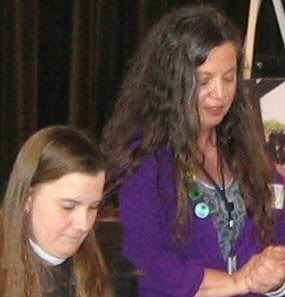
The Rev. Dr. Paige Blair Episcopal Priest & Bonnie N. Davis
Buddhist
First NEIDEEP Conference
Our First Meeting took place in Portsmouth, NH on 2/21/06.
The Rev. Dr. Paige of St. George's Episcopal Chuch (York Harbor), Pastor Sharon Miesel of York-Ogunquit United Methodist Church (UMC)
& Pastor Sue Kingman of Sanford Unitarian Universalist Church (UUC) took part in the Interfaith Service.
Iman Ibrahim Sayer, Boston Dialogue Foundation, did a transforming reading from the Koran in Arabic.
Sister True Virtue, Abbess of the Green Mountain Dharma Center, led a meditation, centering & grounding
the more than 60 participants for the rest of the day.
Rabbi David Mark, Temple Israel in Portsmouth, blew the Shofar,
made from Ram's Horn, reminding us that it is made from the same material as our fingernails &
that the work before us must be done with our hands.
Bishop Pete Weaver, Worldwide head of the UMC at the time of the conference, spoke about trips to Africa, meeting with religious leaders to speak with President Bush,
& attending the Transatlantic Forum on Global Poverty in London prior to the 2005 G8 Summit. The next speaker was Lallie Lloyd, (E4GR) author of
"Eradicating Global Poverty - A Christian Study Guide on the MDG."
Margaret Udahogora, of Rwanda, spoke about educating orphans from her country, also
reminding us of Africa's beauty. Jan Schrock, Senior Advisor of Heifer International and daughter of founder
Dan West, spoke about Heifer's interaction with communities, helping them plan their futures. Suzanne Bowman,
talked about BeadforLife - Ugandan women (many HIV/AIDS positive) making beads and jewelry for two years and now
supporting 170 families. NAACP, Salvation Army and United Way attended as guests with clergy and
other participants. Program stressed MDG, trade issues, & activisim.
Millennium Campaign Pledge & ONE Declaration were signed - "No Excuses" White Wristbands were handed out with
resource guides. By setting the example of working together across potitical, cultural, spiritual & religious boundaries,
we can make an amazing difference.
Interfaith Communities Can Heal the World!
A second round of NEIDEEP is planned for Spring 2008.
Activating New England will make a difference in ending extreme poverty. After all, we hosted a memorable
tea party that changed the course of history.
In a world where so many go hungry,
Let us make the fruits of creation available for all.
In a world where one billion of our brothers and sisters do not have safe drinking water,
Let us help the waters run clear.
In a world where so many die so young,
And so many mothers die in childbirth,
And so many families are ravaged by disease,
Let us bring health and healing.
In a world where women carry such heavy burdens,
Let us recognize and restore the rights of all.
Let us join together, with a new sense of global community,
A new awareness of our need for one another,
And for this fragile planet,
To meet the clear challenge of the Millennium Goals,
To bring hope as substantial as bread,
To make human dignity as visible as wheat in the fields.
Special thanks to The Rev. Mike Kinman for his assistance on how to set up a cool blog!